




Travel Risk Academy Partner Trvlher Rebrands to Duly and Launches AI-Native Travel Risk Agents
Travel Risk Academy (TRA) is delighted to share an exciting development from one of its valued partners, Trvlher, which has officially rebranded to Duly, alongside the launch of its new AI-native travel risk agents. The rebrand marks an exciting new chapter for the company as it continues to innovate in the travel risk management sector, helping corporate travel and security teams make more informed decisions while strengthening traveller safety and duty of care. Introducing Duly: AI-Native Travel Risk Intelligence Duly is an AI-native travel risk and decision-support system designed to help organisations make smarter, safer and more informed corporate travel decisions. Combining first-hand property intelligence, company requirements, destination risk, individual traveller needs and trip context, Duly’s AI-powered agents provide tailored recommendations to help organisations identify suitable accommodation and better prepare employees for business travel. By bringing together multiple sources of travel risk intelligence, Duly aims to simplify complex decision-making and support a more proactive approach to corporate travel safety. Smarter Travel Risk Management Without Changing Booking Processes One of Duly’s key advantages is its ability to support existing corporate travel booking processes without requiring employees to change how they book. Rather than replacing established booking systems, Duly provides an additional layer of intelligence and decision support, helping travel managers, security professionals and organisations assess suitable travel options against their specific requirements. Duly recommends. Your team decides. This approach enables organisations to strengthen travel risk management practices while maintaining flexibility and control over their travel programmes. Supporting Innovation in Travel Risk Management At Travel Risk Academy, we recognise the importance of innovation, collaboration and technology in advancing travel risk management and supporting organisations in meeting their duty of care responsibilities. As corporate travel continues to evolve, access to reliable intelligence, informed decision-making tools and practical risk management solutions is increasingly important. We are delighted to see our partners developing technologies that support safer business travel and help organisations take a more informed, proactive approach to managing travel-related risks. Congratulations to the Duly team on this exciting new chapter! We look forward to continuing our partnership and following their progress as they bring new capabilities to the corporate travel and security sectors. Discover more about Duly and its AI-native travel risk agents here >
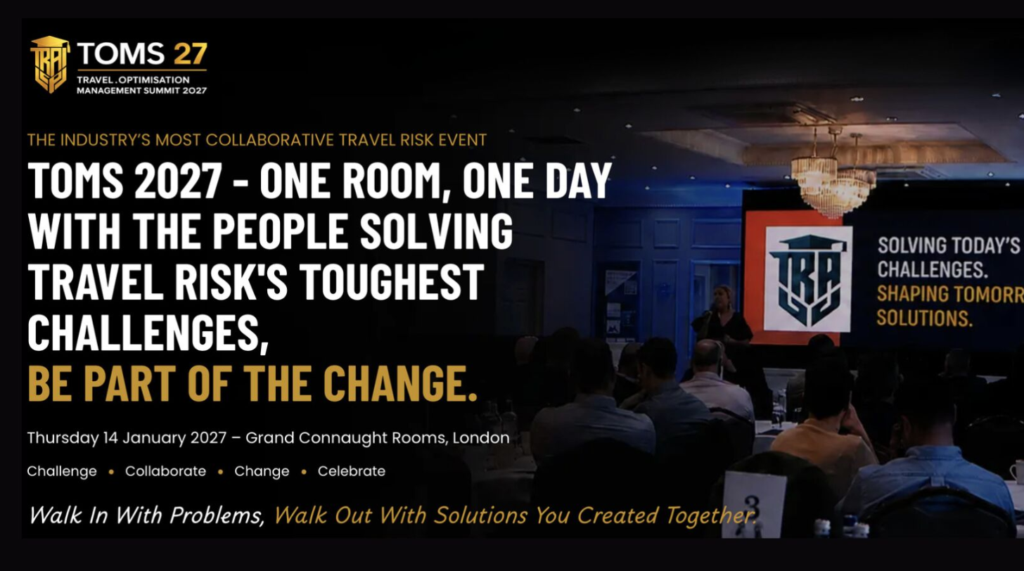
TOMS27: Bringing the Global Travel Risk Management Community Together in London
Why should I come to the Travel Optimisation Management Summit (TOMS27)? Why industry leaders, travel risk professionals and organisations are coming together at TOMS27 to challenge thinking, share expertise and shape the future of travel risk management. The travel risk management industry is evolving. From advances in technology and artificial intelligence to changing traveller expectations, duty of care responsibilities and the growing importance of collaboration, organisations are facing new challenges in how they protect and support their travelling workforce. On Thursday 14 January 2027, travel risk management professionals, industry experts, technology providers and business leaders will come together at the Grand Connaught Rooms in London for TOMS27 – the Travel Optimisation Management Summit, hosted by Travel Risk Academy. But TOMS27 isn’t your typical travel risk conference. Designed as a live, interactive travel risk management lab, TOMS27 is bringing together the people, organisations and ideas helping to shape the future of the industry. And with an impressive community of sponsors, mentors, contributors and delegates already supporting the event, there’s plenty to look forward to. What is TOMS27? TOMS27 (Travel Optimisation Management Summit 2027) is an industry event organised by Travel Risk Academy, bringing together professionals working across travel risk management, corporate travel, traveller safety, security, insurance and technology. Taking place in central London on 14 January 2027, the event combines interactive discussions, practical workshops, industry collaboration and an evening awards celebration. Unlike traditional conferences, where attendees spend much of their time listening to presentations, TOMS27 has been designed to encourage participation. The idea is simple: bring the right people into one room, encourage meaningful conversations and work together to tackle some of the industry’s most pressing challenges. The event will explore five key areas: Visibility: How can organisations gain a clearer understanding of where their travellers are and the risks they face? Communication: How can we make travel risk information more accessible, relevant and actionable? Technology integration: How can organisations make better use of existing systems and emerging technologies? Insurance: How can travel risk management and insurance work more effectively together? Artificial intelligence: What opportunities and challenges does AI present for the future of travel risk management? These discussions will bring together perspectives from across the travel risk management ecosystem, encouraging collaboration between organisations that may approach the same challenges from very different directions. Why collaboration matters in travel risk management Effective travel risk management doesn’t happen in isolation. Travel managers, security professionals, HR teams, insurers, technology providers and assistance companies all have a role to play in supporting safer business travel. Yet, too often, these disciplines operate independently. TOMS27 aims to help break down those silos, creating an environment where industry professionals can share their experiences, challenge established thinking and explore practical solutions together. For Travel Risk Academy, this approach reflects the very reason the organisation was established: to connect the global travel risk management community, improve access to knowledge and encourage meaningful progress across the industry. Meet the organisations supporting TOMS27 TOMS27 is supported by a growing network of organisations working across different areas of travel risk management, traveller safety and business travel technology. Their involvement reflects the importance of bringing different perspectives into the conversation. Compass Point Assist – Headline Sponsor As the Headline Sponsor of TOMS27, Compass Point Assist is playing an important role in supporting an event dedicated to advancing travel risk management. Working in the field of assistance and traveller support, Compass Point Assist brings a valuable perspective to discussions around duty of care, incident response and supporting people when things don’t go to plan. “Supporting TOMS27 means being part of a wider community that is focused on improving how travel risk is understood and managed. For us, it is about supporting collaboration, sharing experience and learning from others across the industry. Events like TOMS bring together people with different perspectives and expertise, which creates a valuable opportunity to have meaningful conversations about the challenges organisations are facing and how the industry can continue to improve.” – Compass Point Assist SureSIM – Improving connectivity and traveller visibility In an increasingly connected world, reliable communication and traveller visibility are essential components of an effective travel risk management programme. SureSIM, part of Utelize Mobile, provides international eSIM connectivity solutions and location awareness capabilities, helping organisations address some of the practical challenges associated with managing travelling employees. As a TOMS27 sponsor, SureSIM will contribute to discussions around technology, communication and the importance of keeping travellers connected. TOMS is one of the few events built around solving real problems rather than pitching at them – the agenda covers exactly the stuff we deal with day to day, from traveller visibility to tech and data integration. That practical, roll-up-your-sleeves format is rare in this industry, and it’s why we wanted to be in the room.– Matt Atkinson, Managing Director Valpas – Raising standards in accommodation safety Accommodation safety is an important consideration for organisations responsible for business travellers. Valpas is helping to address one particular area of accommodation risk through its bed bug safety technology and certification programme. Its involvement in TOMS27 brings an accommodation-focused perspective to the wider conversation around traveller wellbeing, risk mitigation and hotel safety standards. “TOMS puts experienced practitioners, TRA mentors and Level 4 and 5 learners in one room. That keeps the conversation grounded in real programmes. It’s also where accommodation standards for travel risk get shaped – early, and by the people who will use them.” – Valpas WorkFlex – Supporting safer international business travel Managing international business travel can involve complex compliance, safety and duty of care considerations. WorkFlex supports organisations managing international work and business travel, including through its WorkFlex SOS offering. As a TOMS27 sponsor, WorkFlex brings expertise in the challenges faced by organisations operating across borders. “Because it does something different: It treats travel risk as a cross-functional discipline rather than a security specialism. HR, travel, procurement, compliance and security people rarely sit in the same room to talk about this which is precisely where the silos TRA talks
TOMS27: Bringing the Global Travel Risk Management Community Together in London Read More »


Why User Experience Matters in Travel Risk Management
When evaluating travel risk technology for your travellers, response teams and wider travel risk management (TRM) programme, it is essential to look beyond feature lists and compliance checkboxes and consider the overall user experience (UX). Vendors that really understand who they are creating products for, really understand your challenges and objectives. A well-designed UX has a direct impact on how effectively stakeholders can achieve their goals, particularly when the pressure is at its highest during a crisis. In the world of travel risk, where incidents can stack up and escalate rapidly, people’s safety may be at stake, UX extends far beyond pretty screens and dashboards. UX encompasses everything in how you interact with technology, the way information is delivered, decisions are supported and users are guided throughout their journey … from their first day of employment to their last. As travel disruption becomes increasingly unpredictable and emotionally charged, your TRM platform should provide timely intelligence, accurate risk assessments, clear communication and coordinated decision support with credibility, clarity and empathy. That is what a great user experience truly feels like. Why poor UX creates travel risk Unfortunately, poor UX often remains one of the most overlooked aspects of travel risk technology. Confusing interfaces, complex workflows, excessive training requirements, unreliable data, poor integrations and software riddled with bugs can all undermine an organisation’s ability to respond effectively when it matters most. Too often, platforms are bought on the strength of marketing campaigns, feature comparisons, pricing strategies, or compliance claims. While the day-to-day experience of those who rely on the technology receives less attention. When assessing current or future solutions, organisations should seek vendors that genuinely understand their users, from travellers and response teams to leadership and external partners. Placing the end-to-end user experience at the centre of their product design. Their web platforms, dashboards, mobile apps, communications and workflows should all reflect this understanding. If they don’t, it’s worth questioning whether they’ll truly deliver when your people need them most. The following topics explore how user experience influences the entire travel risk management journey. Expressed as verbs and not as a process or cycle, you need to revisit each topic frequently and understand the inter-relationships to create a more proactive and adaptive travel risk management program. Assess: Identifying, analysing and mitigating the world The first important part of any approach to risk is having an effective UX to build a model of your business and travel programs. Traditionally built as a risk register, we perhaps should imagine a more proactive, real-time and adaptive solution that highlights known and potential threats, vulnerabilities, non-compliance and analyse potential impact. A great UX recognises all of this alongside a deeper understanding of the roles and responsibilities of the key stakeholders. Those risk analysts, security and travel managers, HR, IT, legal teams, leadership etc. need well designed tools to ensure these controls, priorities and objectives are actually in place. It is also crucial to ensure employees understand how risks affect them personally, their travel and the wider business. Travel assessments in particular should not only follow the organisation’s policy, but articulate them in an engaging form the employees will actually care about and take heed of. A more future thinking UX would be to absorb team experience, historic data and external advice to automate building much of what we cover here. Not forgetting that stakeholders are guided back to reassess when events are fresh in the minds rather than visiting policy say once a year. Implement: Putting words into action, digitising policy Moving from stagnant risk policies and registers … to a dynamic, adaptive travel risk solution is a leap from theory to practice. Being able to meaningfully configure risk technology to be intuitive, logical and accessible maybe the difference between success and failure. UX is a key aspect of how policy is articulated and understood. It is how response teams and travellers are expected to act given those threats and vulnerabilities. Any technology you configure and deploy … needs to be trusted, effective, accessible and intuitive. Implementation is not just about configuring your technology and leave it be … it requires continuous monitoring and improvement from multiple business functions to maintain its effectiveness. The best UX in technology allows you to test changes made and make sure those changes are ready to deploy. Careful consideration during implementation to ensure critical communications will be received, spotted, read, understood and actioned upon. Having clear visibility into data quality at this point before policy goes into effect is incredibly important. Any issues found in building policy at this point should be fed back into assessments and risk registers. Engage: Working with real people to learn, adopt, act and care Driving engagement with a mobile workforce is the most overlooked hurdle in travel risk technology, yet success may hinge entirely on human behaviour during an incident. This UX starts with engaging those employees to ensure their profile data is correct and up to date. To build a successful program, safety tools and communication strategies must be designed from the traveller’s perspective and every interface element, visual cue and tone of language guides how employees may perceive or react to threats. This includes intuitively distinguishing between a lower priority assistance request and a high-consequence SOS panic button. True engagement is deeply tied to user trust, consent and personalisation. Meaning travellers are far more likely to install and update safety apps and share their location if the process is transparent and clearly articulates personal benefits. By replacing generic, boring PDF Email attachments with bite-sized, frictionless pre-travel assessments tailored to specific destinations, organisations can reinforce relevancy when it comes to data privacy alongside compliance. A great UX also empowers employees to understand their responsibilities and safety before departure, so they are already prepared before incidents occurs. Test: Checking policy is ready, valid and working No matter how faultless your risk register, advanced your security technology, or complete your travel risk program are, they may only be as effective as the last event,
Why User Experience Matters in Travel Risk Management Read More »

Travel “Like an Air Marshal”
Travel “Like an Air Marshal” When I was flying with the Air Marshals, I averaged anywhere from 2–5+ trips a week (sometimes 3x that much) depending on location. When you travel this much, you learn fast what works and what doesn’t. Here are 3 things that helped me travel with more resilience and organization. PACKING CONSIDERATIONS: 1st Line Items you’ll always keep on your body and in your control. This includes going to the bathroom or if you must evacuate quickly. A fanny pack works well, but any small bag will do. – IDs / Passports– Money / Credit Cards– Phone(s) and charger– Notepad or paper with safety contacts, addresses, etc. – Business docs (thumb drives)– Medical – maybe a small tourniquet Keep it light. Find out what works for you and what can move to the 2nd line. This will change every trip. 2nd Line Think backpack or small carry-on. “Keep it close, grab it fast.” Pack your travel clothes here to avoid checking a bag when you can. Keep a sub-pouch for sustainment and business docs inside. – Extra clothing or layers, workout clothes (travel back outfit + shower kit)– Photocopy of your passport– Water bottle– Business documents / papers– Medical kit– Jewellery / Valuable items 3rd Line Checked luggage. Use only when absolutely necessary. Extra clothing and anything that won’t fit in your carry-on. COMMUNICATIONS Start a group message with your travel team. This is your mini-Ops center for communication and situational awareness. Information to consider going in this group: 1 pinned/starred message with emergency contact information and addresses for the local area (hotel, meeting locations, embassies, police stations, hospitals) Everyone’s hotel room numbers (accountability) Team movements. If you split up, drop it in the group. Even spies let someone know where they’re going. Technical considerations: Have a plan for when technology fails. WiFi: Unless you’re bringing your own router/sim, treat everything you do, say, or send over any WiFi (especially abroad) as monitored. Consider eSIMs and VPNs. Sharing your location: On personal trips, I always let a close friend know where I’ll be. I never posted that I was travelling. Sharing your location online creates two risks: people near you know where you are (think celebrity robberies), and people at home know your house is empty. KNOW WHERE YOU ARE – MAPS AS A TOOL This is my favourite topic. When I was 10, my dad, brothers, and I drove halfway across the country to see some family. When I got in the car, he handed me a big book of maps and said “get us to Ohio” … that’s literally all he said. I was hooked and have been fascinated with and used maps in every aspect of my life since. Cool story… so anyway: Maps are a tool for situational awareness, storing information, and communicating quickly. Here’s a basic, free way I use maps while travelling. This concept scales to any situation, but to keep things simple, we’ll use Google Maps from an individual perspective, not a team. SCENARIO You’re travelling to Pinehurst, NC for work. Staying at the Pinehurst Resort, meetings at the Pinehurst Country Club. Here are the basic steps to create a framework for resilience using maps. Always download offline maps. Done within the app. Go to Menu > Offline Maps > Select Your Own Map. Zoom to your area and download. (Download a little more than you think you need.) 2. Create lists. Create different lists for different location types. Use icons so your brain instantly reads them on the map. Even without cell service, you can navigate using offline maps + your pinned lists. You can also create 1 list with all locations. The limitation: all pins look the same, but you can share the whole list easily. 3. Pin locations. Search for and pin key locations. For the Pinehurst example: The hotel Meeting locations Emergency room Police station Restaurant for the business dinner 4. Share your locations. Share your lists with family, coworkers, or your travel team. Add multiple locations per list. If you use the 1-list option, sharing all locations at once is easier, but remember the limitation. (There is a way to create one map with multiple different pin types, but we’re keeping things simple for today.) These are three basic concepts that worked for me. Everyone’s different, every trip is different. Find what works for you and build it into your process. If you have questions on how to scale these concepts, implement them into your culture or policies, or discuss other tools and techniques for your people while travelling, feel free to reach out. Written by TRA Mentor Sal Szwed
Travel “Like an Air Marshal” Read More »
Why Travellers Tune Out Risk Messages and How Organisations Can Change That
Why Travellers Tune Out Risk Messages and How Organisations Can Change That. Working in travel risk, you have probably had the experience of sending an important update and wondering whether anyone has actually read it. Perhaps you have prepared destination guidance ahead of a trip, issued an alert about a developing situation, or rolled out a new traveller tracking process that you know could make a genuine difference if something goes wrong. And then… nothing. No questions. No engagement. No evidence that the message has landed in the way you intended. It can be frustrating, particularly when you know the risks are real and the information you are sharing could help people make better decisions. The trap of assuming information equals engagement Sometimes it can be a matter of unfortunate timing. When an employee receives a travel risk update, they may be focused on something else entirely: a client meeting, important presentation, a conference, a project deadline, or a flight that has just been delayed. Travel risk is one consideration among many competing for their attention. That does not make your message less important, but it does means it needs to work harder than we sometimes expect. Another challenge is assuming that because information has been shared, it has been understood. The guidance may have been circulated, and the traveller has ticked a box confirming they have read it. However, has it really gone in? We know that people are often overloaded with information. Most employees receive more emails, alerts and notifications from multiple channels in a day than they can realistically absorb. In that environment, even genuinely important messages can struggle to cut through. The answer is not necessarily to communicate more. If travellers receive a constant stream of warnings, reminders and alerts, they can become desensitised. Everything starts to feel equally important, which often means nothing feels particularly important. That is why a genuinely significant update can end up receiving the same level of attention as the last five routine communications. The issue is not simply volume, it is relevance. Information isn’t enough Consider the travel updates you pay attention to yourself. It is likely information that feels immediately relevant to your plans: a transport strike affecting your route, a security incident near your hotel, or a sudden change to entry requirements for a country you are due to visit. Those updates cut through because the connection between the information and the decision you need to make is obvious. The same principle applies to travellers. Risk messages can struggle when organisations focus on sharing everything people might need to know, rather than identifying the few things they genuinely need to know right now. That does not mean every message needs to be personalised. For most organisations, that is not practical. But it does mean considering what is likely to matter most to a traveller at a particular point in their journey. What questions are they already asking? What decisions are they about to make? What would genuinely help them feel more prepared or confident? In many cases, a short, timely message linked to a specific destination, event or emerging situation will have far more impact than a detailed briefing sent weeks earlier. The challenge is not simply getting information in front of people. It is helping them understand why it matters to them. Trust matters more than many organisations realise One theme that comes up regularly in travel risk programmes is traveller tracking. From a risk management perspective, the rationale is obvious. If an incident occurs, knowing who may be affected allows the organisation to provide support quickly and effectively. Yet travellers do not always see it through that lens. We know that using terms such as “traveller tracking” or “travel tracking” can create an impression that organisations are monitoring an employee’s movements throughout a trip. Unsurprisingly, that can raise concerns about privacy, surveillance and how information is being used. Of course, the purpose is usually very different. Most organisations are not interested in where travellers are on a day-to-day basis. They simply need to understand who may be affected if an incident occurs and how to provide support quickly when it is needed. That’s why we now suggest using the term “location awareness” as it better reflects the purpose of the capability and shifts the focus from monitoring to support. People are more likely to engage with a process when they understand how it benefits them. Explaining how location information helps an organisation contact and support travellers during an emergency is often more persuasive than simply telling employees they must comply with a policy. The process and technology are the same, but the way it is described is different. And that can have a significant impact on how travellers respond. One message will not resonate with everyone Another reason travel risk messages can miss the mark is that “travellers” are not one audience. A senior executive who travels internationally every month may want a concise summary of what has changed and what decisions need to be made. Someone travelling overseas for the first time may need more context and reassurance. A project team going to a higher-risk location may need a proper briefing, not just a link to guidance. The same information is unlikely to resonate equally with everyone – people bring different levels of experience, confidence, knowledge and concern to a trip. They are also likely to be interested in different things. That is where communication becomes more nuanced. It is not simply about making information available but is about considering what is most relevant to a particular audience, what questions they are likely to have and what would help them feel informed and prepared. Communication is more likely to land when it is written with a specific audience in mind, rather than assuming every traveller will engage with the same message in the same way. Language matters Often, the difference between a message that lands and one that is ignored is not the information
Why Travellers Tune Out Risk Messages and How Organisations Can Change That Read More »