Travel Risk Management

Level 4 Scholarship Students

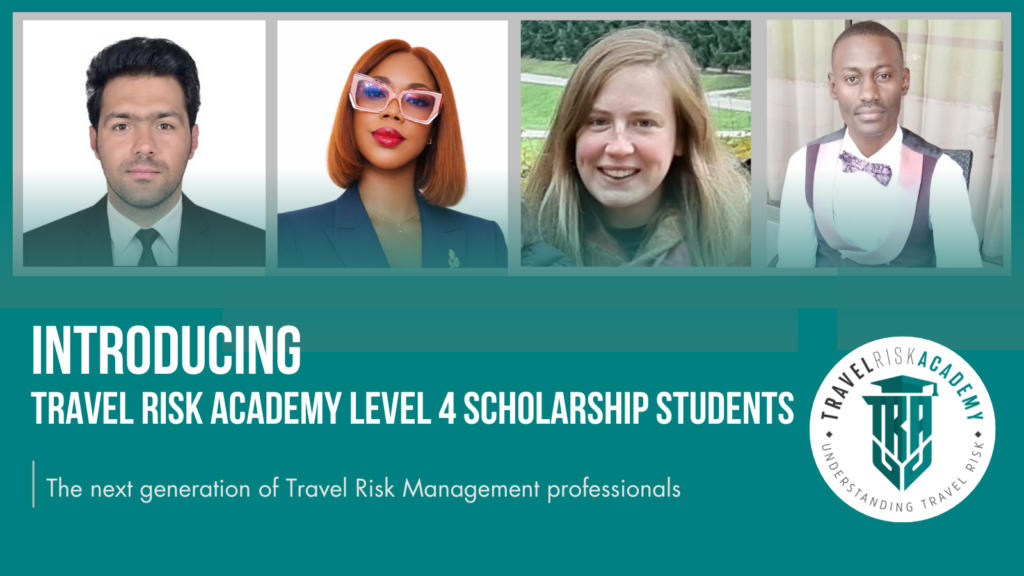
Travel Risk Academy Scholarship: Meet Our Level 4 Recipients

We’re proud to introduce the four recipients of our Level 4 ATHE Award in Travel Risk Management scholarship: Mohammad Shafi Waris, Deborah Nwaukwa, Allan Kyeyune, and Daisy Barnham Selected from a highly competitive global pool, these individuals represent not only exceptional talent, but also the diverse perspectives that are essential to shaping the future of Travel Risk Management (TRM). A Truly Global Cohort This inaugural scholarship intake brings together professionals from the UK, Uganda, Afghanistan, and Nigeria – a reflection of the global nature of TRM today. “We’re delighted to welcome students from across the world into our inaugural intake. At our core, we believe that Travel Risk Management is a truly global discipline — one that thrives through diverse perspectives. These students have been practising TRM in their own ways for years, and we’re proud to now equip them with the tools and frameworks to further develop and advance TRM practices within their countries, and for generations to come.”Bex Deadman, Co-founder, Travel Risk Academy Powered by Partnership The Travel Risk Academy initially committed to funding two scholarships for the March cohort. Thanks to the generous support of AHNA Group, we were able to double this number — awarding a total of four fully funded places. This kind of collaboration is what makes meaningful, global impact possible. A Strong Global Response Interest in the scholarship programme has been overwhelming. We received applications from across the globe, including: Afghanistan, Brazil, Canada, India, Indonesia, Ireland, Nigeria, Uganda, the UK, and the USA. This level of engagement highlights both the growing demand for TRM education and the importance of making it accessible worldwide. Now Inviting New Partners We are now opening the door to a limited number of organisations interested in sponsoring future scholarships. By partnering with Travel Risk Academy, you can: ✔ Support the global development of Travel Risk Management✔ Expand access to training for professionals who may otherwise be excluded✔ Strengthen your reputation as a values-driven organisation✔ Build meaningful connections within a fast-growing TRM community Sponsorship Options 1 place – £699.99 + VAT 5+ places – 5% discount 10+ places – 10% discount Enquire: en*******@***************my.com Applications Now Open: September Intake We are now accepting applications for our September scholarship intake. If you’re passionate about advancing Travel Risk Management in your region and want to gain a globally recognised qualification, we encourage you to apply. 👉 Apply here >

Travel Risk Academy Scholarship: Meet Our Level 4 Recipients Read More »

AI-Enabled Fraud

When the Threat Travels With Your People: AI-Enabled Fraud and the Duty of Care Gap

The Moment of Maximum Vulnerability Crisis disruption does not simply strand travellers. It creates the conditions in which they are most susceptible to manipulation. When flights are cancelled, rebooking queues are overwhelmed and official guidance is fragmented, travellers do what comes naturally: they search for help, they post on social media, they click on links that appear to offer resolution. Fraudsters understand this behaviour precisely because it is predictable, and they have learned to exploit it at scale. The Middle East conflict of early 2026 produced a textbook case study. Within days of widespread flight disruption across the Gulf, a coordinated wave of AI-assisted fraud activity targeted passengers of Emirates, Etihad and Qatar Airways. The techniques deployed were not crude. They were architecturally sophisticated, operationally fast and, in several cases, difficult to distinguish from legitimate airline communications. For corporate travel risk managers and duty of care professionals, this is not a consumer issue that sits at arm’s length. It is an operational exposure with direct liability implications. Four Attack Vectors Your Travellers Are Facing 1. Fake Social Media Accounts Impersonating Airlines On the platform X, fraudsters constructed accounts using airline branding, logos and generic service-oriented names such as “Support Team”, “Quick Response Team” or “Guest Services Care.” These accounts actively monitored public posts from distressed passengers and replied directly, initiating contact under the appearance of legitimate assistance. Santander UK’s fraud team confirmed it had already received reports from customers caught in this pattern. Etihad Airways issued a formal advisory on 11 March 2026 confirming the existence of multiple fake accounts impersonating the airline, and clarified that its only verified accounts on X are @Etihad and @EtihadHelp. The mechanics of the scam followed a consistent pattern: the passenger is drawn into a direct message exchange, asked to confirm personal and contact details, then directed to a money transfer application under the pretence of receiving a refund. Instead, funds are debited. Duty of care implication: Your travellers are searching for help in real time, often on personal devices, using personal accounts. Their interactions with apparent airline support are invisible to your travel management infrastructure. There is no trigger in your booking or tracking platform that flags this exposure. 2. AI-Generated Identities Used to Fabricate Credibility Bellingcat’s investigation into the case of “Tamara Harema”, published on 12 March 2026, documented a more elaborate variant. An interview was published in De Telegraaf, the Netherlands’ largest newspaper, featuring a woman claiming to organise private evacuation flights from Dubai at €1,600 per seat. The article reached the desk of the Dutch Foreign Affairs Minister. Subsequent analysis found multiple AI generation artefacts in the published photograph: distorted architectural features inconsistent with the actual Burj Khalifa, a furniture anomaly, blurring on clothing and an earring that appeared to merge into the subject’s face. Flight-tracking data from Flightradar24 confirmed that no aircraft matching the described A321 departed Muscat bound for the Netherlands on the stated dates. The source who introduced “Harema” to the newspaper was a Dubai-based lawyer with a documented history of fraud-related insolvency proceedings in the Netherlands. The fraud did not require a sophisticated technical operation. It required a convincing AI-generated image, a plausible narrative, and a trusted intermediary willing to make an introduction. In a crisis environment, those three ingredients are readily assembled. Duty of care implication: When a traveller cannot secure a seat on a repatriation flight, they will seek alternatives. An AI-generated persona offering charter capacity at a credible price point, promoted through a credible channel, is indistinguishable from a legitimate operator to someone under stress and time pressure. 3. Fraudulent Refund Links Distributed via Social and Email Both Emirates and Etihad issued explicit warnings against sharing booking information, contact details or payment data in response to social media posts. The UAE Ministry of Interior separately warned on 4 March 2026 against fraudulent emails purporting to offer emergency registration, compensation or insurance, which directed recipients to fake forms designed to harvest personal and financial data. Abu Dhabi Police confirmed that fraudsters deliberately target periods of travel disruption, when passengers are actively expecting communications from airlines and official bodies, making fraudulent messages proportionally more convincing. Duty of care implication: Travellers with corporate bookings are likely to use corporate payment instruments. A successful refund scam executed through a corporate card or virtual payment credential creates both a financial exposure and a data breach event. 4. AI-Generated Service Listings Beyond the Airline Channel While not specific to the current crisis, Bellingcat’s March 2025 analysis of AI-generated product fraud on platforms including Amazon, eBay and Etsy documents the systematic use of AI-generated imagery to misrepresent goods. The techniques identified, including image inconsistencies, missing product angles, implausible pricing and fictitious seller identities, are directly transferable to the sale of fake travel services: non-existent hotel accommodation, fabricated airport transfers and fraudulent visa facilitation. During a regional crisis, demand for any available service spikes sharply. Travellers will book accommodation, ground transport and logistical support through channels they would not ordinarily use. The fraud surface expands accordingly. Why This Is a Technology and Governance Problem, Not Just User Behaviour It is tempting to frame this as a traveller awareness issue, which it partly is. However, the underlying challenge is structural. AI-generated content has crossed the threshold at which visual and contextual plausibility can no longer be reliably assessed by an individual under cognitive stress. The Harema case demonstrates this clearly: the photograph deceived a professional newsroom long enough to be published and cited at ministerial level. The expectation that a distressed traveller, operating alone, on a mobile device, in an unfamiliar environment, will perform rigorous open-source verification before clicking a link or making a payment is not a reasonable control. Corporate travel risk programmes that rely on traveller awareness as their primary defence against AI-enabled fraud are operating with an inadequate control architecture. What Robust Organisational Controls Look Like Travel risk managers and technology leads should be examining the following areas: Pre-trip briefing, updated for AI fraud vectors. Travellers operating in elevated-risk regions should receive explicit, scenario-based guidance

When the Threat Travels With Your People: AI-Enabled Fraud and the Duty of Care Gap Read More »

TRA 2025 Review

2025 Review: Building the Future of Travel Risk & Travel Optimisation

As we wrap up another remarkable year, we want to extend our heartfelt gratitude for your continued support. With the festive season in full swing, we’re excited to share our end-of-year review – highlighting key moments and milestones, along with a few updates and warm wishes as we head into 2026. A Landmark Achievement for the Industry This year marked a genuine “I was there” moment for the industry. The world’s first formal certification in Travel Risk Management at Level 4 was awarded to Andrew Lowe, Travel Risk Manager at BP. He became the first graduate of the Travel Risk Academy ATHE Level 4 Award in Travel Risk Management. As a result, he has set a new benchmark for professional standards in the field. This global first reinforces Travel Risk Academy’s mission to educate, inspire and qualify those responsible for keeping travellers safe. It also supports organisations in building effective and optimised travel programmes. Evolving Qualifications: Level 5 Moves Into Beta Building on the success of Level 4, the ATHE Level 5 Award in Travel Risk Management has now entered beta testing. A highly engaged group of Travel Risk Managers and practitioners are taking part. These Level 5 beta cohorts are working closely with Travel Risk Academy to refine, stress-test and adapt the programme. Their goal is to ensure the course truly reflects the realities of today’s complex, tech-enabled and fast-changing world. Their feedback is shaping content around ISO31030, cross-functional collaboration and Travel Optimisation Management. Consequently, Level 5 is becoming not only academically robust but also practically indispensable. Communities Regrouping for 2026 The Travel Risk Academy Communities remain central to how TRA turns learning into action. They also drive meaningful industry-wide change. Throughout the year, our DEI and Technology & Data communities met regularly to explore how identity, health, automation, data integration and AI continue to reshape the traveller risk landscape. These communities are now regrouping and re-evaluating their aims. They are preparing for a refreshed relaunch in January 2026, with clearer objectives, more structured projects and greater opportunities for members to contribute and lead. Learning, Events and Membership in 2025 Throughout 2025, Travel Risk Academy expanded its portfolio of courses, workshops and webinars. These covered every stage of the TRM learning journey, from introductory ISO31030 training to the ATHE Level 4 and Level 5 qualifications. The Travel Optimisation Management Summit (TOMS Week) returned in May as an immersive online experience. It brought together professionals from around the world to explore how to reduce risk while optimising travel programmes. Through Travel Risk Academy Membership, individuals and organisations gained access to webinars, workshops, resources and community groups. This support helped members move beyond tick-box compliance and develop truly optimised, resilient travel programmes. Co-Founder Reflections Bex Deadman, Co-Founder “From humble beginnings, 2025 has been a year of delivery. We are incredibly proud of our first students joining the Level 4 and Level 5 TRM Qualification cohorts. This milestone is the first step in meaningfully professionalising TRM, and supporting this community has been our honour.” Sara McKenna, Co-Founder “2025 was a year of discovery and genuine delivery for Travel Risk Academy. Our qualifications sit at the heart of all we do. I believe our approach – leading with the heart – will help the TRA become a true professional home as Travel Risk Management evolves into Travel Optimisation Management. A huge thank-you to our learners, mentors, speakers, partners and clients for their trust and energy. We look forward to even more innovation in 2026.” Simon Crane, Co-Founder “2025 was a landmark year for Travel Risk Academy. Our first student achieved the ATHE Level 4 Award in Travel Risk Management — the only independently accredited qualification of its kind worldwide. This milestone demonstrates the importance of these awards and the rising demand for professional development in travel risk management. We are thrilled to see more highly experienced managers preparing to enrol for the Level 4 and Level 5 Awards in 2026.” Looking Ahead: An Invitation to Join Us As Travel Risk Academy grows, the focus remains clear: to be the centre of excellence where TRM professionals learn, share, test ideas and co-create the future of Travel Risk and Travel Optimisation Management. In 2026, TRA will continue expanding its learning platform, membership programme, communities and events. More people will have the opportunity to gain accredited qualifications and help shape how organisations manage travel risk. Whether you are already part of the TRA family, considering formal TRM training or just beginning to explore the field, you are warmly invited to join the movement and help shape what comes next.

2025 Review: Building the Future of Travel Risk & Travel Optimisation Read More »

TRM Level 4 Graduate

A Global First: Andrew Lowe becomes the World’s First Graduate of the Travel Risk Academy ATHE Level 4 Qualification in Travel Risk Management.

Andrew Lowe of BP becomes the World’s First Graduate of the Travel Risk Academy ATHE Level 4 Qualification in Travel Risk Management. We are proud to announce a major milestone: Andrew Lowe, Travel Risk Manager at BP, has become the first person to achieve the Travel Risk Academy Level 4 Qualification in Travel Risk Management, independently accredited by ATHE. This moment marks a significant step forward for a profession that is rapidly gaining recognition as essential to global business resilience, duty of care and organisational security. A trailblazer for the profession Andrew’s path into Travel Risk Management began within BP’s Global Security Operations Centre (GSOC), where he helped define what TRM should look like for one of the world’s largest energy companies. From mapping global travel risks to creating frameworks and embedding best practice, his work has set a benchmark for modern Travel Risk Management roles. By becoming the world’s first graduate of the Travel Risk Academy ATHE Level 4 qualification, Andrew has demonstrated how structured training and accreditation can elevate both individual capability and organisational confidence. Andrew commented on his learning journey: “This qualification is a milestone in my journey as a travel risk manager, helping to both solidify and expand my knowledge and experience. Certification is especially important at a time when the profession is being increasingly measured against ISO 31030.” He added that the course provided clarity, structure, and challenge: “The self-paced format worked very well around a busy schedule. The tutorials were invaluable for validating and at times challenging my understanding, prompting real self-reflection.” In recognition of his dedication and pioneering achievement, we are delighted to welcome Andrew as a Travel Risk Academy Ambassador. A new era for travel risk professionals With this announcement, Travel Risk Academy is opening enrolment globally for its ATHE Level 4 and Level 5 Qualifications in Travel Risk Management – offering a clear, accredited pathway for those responsible for keeping travellers safe in an increasingly complex world. With special thanks to our Level 4 sponsors; WorkFlex, Terrain 9, Compass Point Assist, Voyage Manager and Sectrn.   For more information on both our Level 4 and Level 5 Travel Risk Management Qualifications, visit >

A Global First: Andrew Lowe becomes the World’s First Graduate of the Travel Risk Academy ATHE Level 4 Qualification in Travel Risk Management. Read More »

Shopping Basket
Scroll to Top