


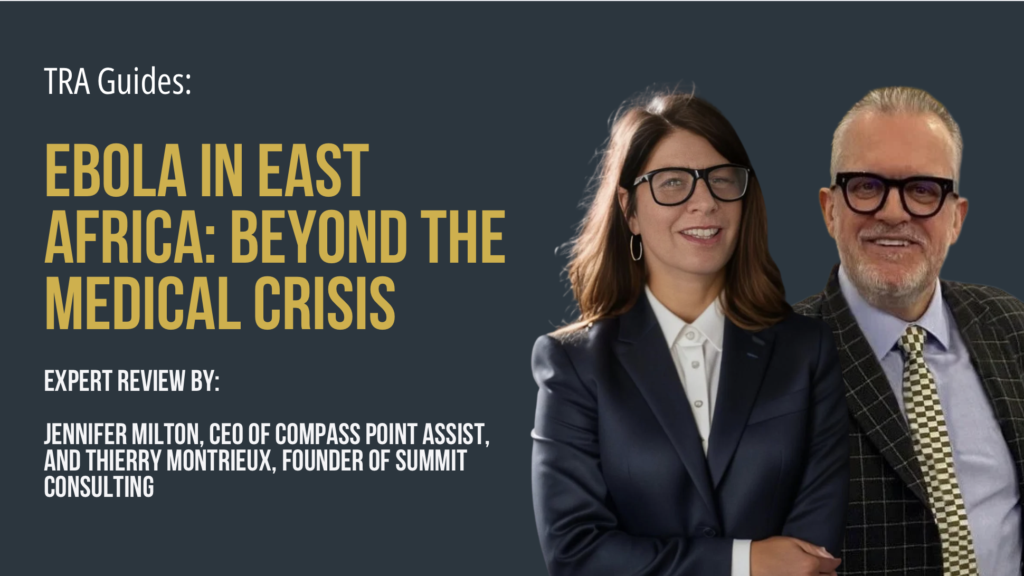
Ebola in East Africa: Beyond the Medical Crisis
A Travel Risk Management Perspective on the Current Outbreak
By Travel Risk Academy | 28 May 2026
Expert review by Jennifer Milton, CEO of Compass Point Assist, and Thierry Montrieux, Founder of Summit Consulting
When the World Health Organisation declared the ongoing Ebola outbreak in the Democratic Republic of Congo and Uganda a Public Health Emergency of International Concern on 17 May 2026, most headlines focused on case numbers and death rates.
As Jennifer Milton, CEO of Compass Point Assist, reminds us:
“Outbreaks like this very quickly become far more than purely ‘medical’ events. In reality, they rapidly evolve into operational, continuity, assistance, and duty of care challenges as well.”
This is the perspective organisations with personnel in East Africa need right now – not just the epidemiology, but the operational reality of what this outbreak means for students, NGO staff, expatriates, and the institutions responsible for their safety.
The Current Situation: What We Know
As of late May 2026, official data show that the outbreak has escalated significantly from early reports.
Democratic Republic of Congo (DRC)
- Around 105 laboratory-confirmed cases
- Around 900+ suspected cases
- Over 200 deaths (suspected and confirmed)
- Affected provinces include Ituri, North Kivu, and South Kivu
Uganda
- 7 laboratory-confirmed cases, all in or linked to Kampala
- 1 confirmed death
- All cases linked to travel from DRC rather than sustained community spread
WHO situation reporting also notes that, by mid‑May, a combined total of several hundred suspected cases and over a hundred deaths had already been reported across both countries, underlining how fast the outbreak has grown from initial detection.
Laboratory capacity remains limited in some affected areas, so many cases remain classified as “suspected” pending confirmation. Public health experts warn the true scale may be higher than official figures due to delayed detection, insecurity, and population movement across porous borders.
What Makes This Outbreak Different
This outbreak involves Bundibugyo virus, a less common Ebola species that has not caused a major outbreak in over a decade.
Two features are particularly important for organisations:
- There are no licensed vaccines specifically approved for Bundibugyo virus disease (BVD).
- There are no approved strain-specific antiviral treatments, although experimental vaccines and therapeutics are under development.
Historical data from previous Bundibugyo outbreaks suggest a case fatality rate of roughly 30–50%, with outcomes heavily influenced by rapid identification, supportive medical care, and robust infection prevention and control.
However, there is a crucial piece of context often missing from outbreak reporting:
“Ebola is significantly less transmissible than airborne respiratory diseases because spread requires direct contact with infected body fluids.”
— Thierry Montrieux, Summit Consulting
Ebola does not spread through the air in the same way as COVID‑19, influenza, measles, or tuberculosis. Transmission requires direct contact with infectious bodily fluids from a symptomatic person.
For most travellers and personnel who avoid direct contact with sick individuals, healthcare settings treating Ebola patients, and funeral activities, the overall risk of infection remains low.
The Operational Reality: Beyond Direct Exposure
From a travel risk and business continuity perspective, the real impact extends far beyond those directly exposed to the virus.
As Jennifer Milton notes:
“Even personnel not directly exposed to Ebola may still be heavily impacted operationally through overwhelmed healthcare systems, movement restrictions, border measures, misinformation, staffing issues, and reduced local infrastructure capability.”
Thierry Montrieux of Summit Consulting adds another layer to this:
“From a travel risk management standpoint, the real question is not only ‘How many cases?’ but ‘How quickly will this overwhelm local systems, and what does that mean for access, movement, and decision-making on the ground?’”
In practical terms, organisations may face:
1. Medical Access Disruption
- Healthcare systems in affected areas may divert resources to Ebola response, reducing capacity for routine and emergency care.
- Non-Ebola patients may experience longer waits, fewer available beds, and delays in diagnostic tests.
- Access to medications, specialist care, and elective procedures may be constrained.
2. Movement and Border Complications
- Enhanced screening at airports and borders (temperature checks, health declarations) can create delays and uncertainty.
- Internal checkpoints and movement restrictions may disrupt road travel and logistics.
- Regional flights and cross-border operations may be rescheduled, rerouted, or suspended on short notice.
3. Medical Evacuation Constraints
This is an area where Thierry’s expertise is especially relevant:
“Medical evacuation for suspected or confirmed Ebola cases may be severely restricted and requires specialist arrangements.”
— Thierry Montrieux, Summit Consulting
- Standard air ambulance services may refuse suspected or confirmed infectious disease cases.
- Specialist isolation-capable aircraft are limited and expensive.
- Destination countries and receiving hospitals may decline to accept cases, even with insurance in place.
The ability to evacuate a sick staff member cannot be assumed; it must be planned and verified.
4. Staffing and Continuity Challenges
- Heightened anxiety may drive staff to seek reassignment or early return.
- Family concerns can influence personnel decisions, especially for students and NGO staff.
- Quarantine or monitoring requirements can affect staffing levels even where infection risk is low.
5. Communications and Misinformation
- Conflicting media reports and social media rumours can undermine confidence in organisational decisions.
- Stigma associated with Ebola may affect team dynamics and community relationships.
- Organisations must provide regular, factual updates to counter fear-based narratives.
What Organisations Should Do Now
From a TRA standpoint, this is the “preparedness window” – the moment to act before pressure peaks.
Review Medical Referral Pathways
- Identify which facilities in your areas of operation are designated Ebola treatment centres and which are available for non‑Ebola care.
- Map reliable local providers for urgent but non‑Ebola concerns (injuries, chronic conditions, routine emergencies).
- Clarify how staff or students should access care out of hours or in remote locations.
Confirm Medical Evacuation Arrangements
- Speak directly with your medical assistance/evacuation providers about infectious disease capabilities.
- Confirm:
- Whether suspected Ebola cases are covered
- What aircraft and isolation equipment are available
- Which destination hospitals will accept such cases
- Likely timelines, approvals, and costs
- Build plans for scenarios in which medevac is delayed, declined, or not viable.
Establish Clear Escalation and Decision Thresholds
- Define what triggers changes in operations: e.g. new cases in your specific city, healthcare systems being overwhelmed, or specific government directives.
- Assign decision-making responsibility and back‑ups in case key people are unavailable.
- Run tabletop exercises with country teams to test who does what, when, and based on which information.
Support Staff and Student Welfare
Thierry’s feedback is particularly relevant here: organisations must anticipate the psychological dimension.
“Organisations should anticipate increased anxiety among staff and families and provide regular factual updates to reduce misinformation and fear.”
— Thierry Montrieux, Summit Consulting
This means:
- Providing short, regular situation summaries in plain language.
- Addressing common myths directly (for example, “Ebola is not airborne” and “casual contact in everyday settings is low risk”).
- Offering confidential channels for staff or students to raise concerns.
- Providing access to psychological support where possible, especially for those in or near affected zones.
- Avoiding stigmatisation of affected regions or individuals.
Plan for Operational Continuity
Organisations should prepare for disruption to:
- Transport and travel (including last‑minute changes).
- Staffing levels due to illness, monitoring, or family-driven departures.
- Supply chains for mission‑critical equipment, medicines, and consumables.
- Access to healthcare and other essential services in remote areas.
This can include remote‑working options, back‑up suppliers, cross‑training staff, and pre‑agreed relocation or hibernation plans for certain operations.
Understanding Individual Risk
For individuals – travellers, students, local staff, expatriates – the key is understanding what Ebola does and does not spread through.
How Ebola Spreads
Ebola spreads through direct contact (via broken skin or mucous membranes) with:
- Blood or body fluids of a person who is sick with Ebola
- The body of someone who has died from Ebola
- Objects or surfaces contaminated with such fluids
- Infected wildlife such as fruit bats or primates
Infectious body fluids can include blood, vomit, diarrhoea, urine, saliva, sweat, breast milk, and semen. Transmission risk is highest during direct caregiving, healthcare procedures, handling contaminated materials, and funeral or burial preparation.
Crucially:
- Ebola is not spread through the air like COVID‑19 or influenza.
- Casual contact without exposure to bodily fluids is generally considered low risk.
Symptoms and When to Act
Symptoms typically begin abruptly and worsen over several days:
- Fever
- Severe headache
- Fatigue and weakness
- Muscle and joint pain
- Sore throat
- Nausea, vomiting, and diarrhoea
- Stomach pain and loss of appetite
Additional symptoms may include rash, red eyes, and unexplained bruising or bleeding, though visible bleeding occurs in only a minority of patients and usually later in the illness.
A person who is not experiencing symptoms cannot transmit Ebola.
Because early symptoms overlap with malaria, typhoid, and other common infections, professional medical assessment is essential – self‑diagnosis is not reliable.
Practical Guidance for Travellers and Expatriates
Lower-Risk vs Higher-Risk Activities
For most travellers and expatriates who avoid direct exposure to ill individuals, healthcare settings treating Ebola patients, or funeral activities, overall risk of infection remains low.
Generally lower-risk activities include:
- Staying in hotels or standard rented accommodation
- Office-based work
- Classroom attendance and routine academic activities
- Routine tourism without exposure to healthcare or funerals
- Eating properly prepared, cooked food
- Casual social contact without bodily fluid exposure
Higher-risk situations to avoid:
- Visiting healthcare facilities unnecessarily
- Attending funerals or participating in burial preparation
- Caring for or having physical contact with individuals who are acutely unwell
- Handling bodily fluids or contaminated materials
- Handling bushmeat or having contact with bats or primates
What Travellers Should Do Now
Before travel:
- Check government and institutional travel advisories for DRC and Uganda.
- Verify that medical and evacuation insurance explicitly covers infectious disease events.
- Identify emergency medical contacts and reputable facilities in your destination.
- Avoid non‑essential travel to areas with known transmission, especially Ituri, North Kivu, and South Kivu.
While in-country:
- Stay informed via WHO, Africa CDC, and local Ministry of Health updates.
- Practice strict hand hygiene using alcohol-based sanitiser or soap and water.
- Avoid unnecessary visits to healthcare facilities.
- Avoid funerals and burial ceremonies, even if culturally sensitive to do so.
- Keep travel plans flexible in case screening or movement restrictions change.
If symptoms develop:
- Do not
- Minimise close contact with others immediately.
- Contact a medical provider or local health authority before presenting in person – call ahead.
- Disclose your recent travel history and any potential exposure.
- Follow official instructions regarding testing, isolation, and contact tracing.
The 21-Day Monitoring Period
Standard guidance is that individuals with potential exposure should be monitored for 21 days, reflecting the maximum incubation period for Ebola.
For organisations, this means:
- Encouraging returning travellers from affected areas to self‑monitor for 21 days.
- Providing clear instructions on what symptoms to watch for and how to seek help.
- Considering confidential reporting and occupational health review for staff or students returning from higher‑risk locations.
Special Considerations for Educational Institutions
Universities and schools with students in or near affected areas shoulder distinct duty of care responsibilities.
Key areas to review:
- Student welfare systems – how unwell students are identified, assessed, and supported.
- Absentee monitoring – spotting patterns that may indicate clusters of illness.
- Referral pathways – who students call, where they go, and how they are accompanied to care.
- Family communications – regular, factual updates to parents/guardians about risks and mitigation measures.
- Contingencies – remote learning or temporary relocation options if local conditions deteriorate.
NGOs and Aid Agencies: Balancing Mission and Safety
For NGOs and humanitarian actors, stepping back is often not an option – but operating “as usual” is also unrealistic.
Core priorities:
- Reinforce community engagement and support local public health messaging to avoid fuelling stigma or misinformation.
- Ensure staff have clear, practical guidance on how to reduce risk during field activities.
- Provide additional psychological support for teams working close to outbreak zones.
- Plan for both the protection of personnel and the continuity of essential services in the communities you serve.
On the practical side, this is where Thierry’s framing lands very clearly:
“The real test for NGOs is whether their crisis plans work at field level — not just on paper. Clarity, local partnerships, and realistic medevac assumptions matter far more than theoretical policies.”
— Thierry Montrieux, Summit Consulting
Information Sources You Can Trust
In a rapidly evolving situation, it is vital to rely on credible, primary sources:
- World Health Organisation (WHO) – outbreak updates and situation reports
- Africa CDC – regional situational updates and coordination messages
- Uganda and DRC Ministries of Health – national guidance and alerts
- ECDC / US CDC – risk assessments, technical overviews, and travel advice
- Embassy or foreign ministry travel advisories for your home country
The TRA View: Duty of Care in a Health Emergency
From a Travel Risk Academy perspective, this outbreak is not only a medical event; it is a duty of care and continuity test.
It is simultaneously:
- A public health emergency requiring medical expertise and outbreak control
- A duty of care challenge requiring clear policies, support structures, and escalation thresholds
- A business continuity scenario requiring planning for operational disruption
- A crisis communication challenge requiring timely, factual, and empathetic messaging
- A stakeholder and reputational risk, especially where decisions impact local communities
As Jennifer Milton puts it:
“Practical preparedness, clear communication, and reliable local support structures become absolutely critical during these types of events.”
This analysis reflects insights from Jennifer Milton (Compass Point Assist) and Thierry Montrieux (Summit Consulting), combining assistance, TRM, and continuity expertise into a single operational lens.
Organisations that invest in those three elements now will be better placed to:
- Protect their people
- Maintain essential operations
- Support local health systems
- Demonstrate responsible, values‑driven leadership during a complex crisis
Serious, But Manageable with Preparation
Taken together, the data and the operational context tell a nuanced story.
The outbreak in DRC and Uganda is serious and still evolving; numbers are rising, and health systems are under pressure. At the same time, Ebola remains far less transmissible than airborne respiratory infections, and travel risk for those avoiding direct exposure remains low.
This is not a situation for complacency – but neither is it a justification for panic or blanket disengagement.
For organisations with people in East Africa, the most responsible course is:
- Calm, evidence-based risk assessment
- Robust preparedness and continuity planning
- Honest, empathetic communication with staff, students, partners, and communities
- Regular review of guidance as new information emerges
From a TRA standpoint, this is exactly the kind of complex, multi-dimensional event that tests the maturity of travel risk management, duty of care, and business continuity programs.
If you need support, please get in touch: en*******@***************my.com